The Kumo AI journey

AgentDesk

Put the Copilot licenses you are already paying for to work — and keep them working. AgentDesk is one continuous program that carries you from an AI-ready foundation, through governance, to a fleet of agents that keeps improving instead of stalling after the pilot.

Most organizations have Copilot licenses and a list of agent ideas, and neither is doing anything yet. The gap is rarely the technology — it is the absence of a path from idea to a production agent that survives real permissions, real data, and real users. AgentDesk is that path: a staged journey so you know where you stand and what comes next, and a continuous delivery model so agents keep shipping without restarting a project every time.

The journey

The path from an idea to a living program

A low-commitment on-ramp gets you from “what could AI do here?” to a first live agent. From there it opens into the program — a continuous engine you enter wherever you actually stand.

The on-ramp
  1. Envision Art of the possible
  2. Readiness Where you stand
  3. Pilot Try it live
into the program
  1. Ground

    AI-Ready Foundation

    A governed data core, a real access model, and a delivery pipeline — so agents reason over something true instead of faster chaos.

    Explore the offering →
  2. Govern

    Governance, Security & Enablement

    The guardrails that make AI safe to say yes to — environment strategy, DLP, Copilot policy, and an intake that turns shadow AI into something sanctioned.

    Explore the offering →
  3. Build & Run

    Copilot & AI Agents

    Where the desk works: agents built in your environment, released one at a time, and kept improving from real usage.

    Explore the offering →
Getting started

Three ways in, in order of commitment

Most people start with a conversation and go as far as makes sense. Nothing here asks you to scope a project or commit to a platform before you have seen the value.

  1. 1
    Envision Art of the possible
    Where you areWhat's possible

    A free Envisioning Session — one hour on where AI actually pays off for you, and what a first move could look like. No commitment, no platform decision.

  2. 2
    Readiness Where you stand
    Ground firstReady to build

    For those interested, a quick read on your environment — licensing, governance, connectors, and data — that places you on the journey, so nothing gets rebuilt that is already fine.

  3. 3
    Pilot Try it live
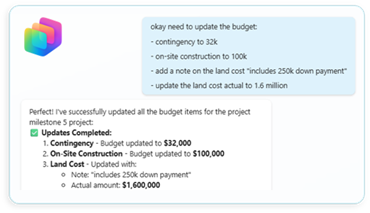
    An AgentDesk agent applying a set of budget updates from a plain-language request and confirming each change

    For teams who want to prove it, we stand up the pipeline and ship your first live agents, leaving a prioritized backlog of the next ones ready to go.

Every path starts the same way — book an Envisioning Session and we will tell you, honestly, which of the three fits where you are.

Why it works

Why continuous beats project-based

Small ideas become viable

A two-week automation is never worth a full project cycle — so it never gets built. In a pipeline it just gets prioritized and shipped, which is where a lot of the real value hides.

You pay for work in motion

Capacity goes to a focused set of agents actively progressing, not twenty things half-started and none finished. As one ships, the next begins.

Value compounds, visibly

AI use cases start small and expand fast. Test, learn, and scale without re-scoping — and watch the fleet and its impact accumulate on one screen.

What you can build

From an FAQ agent to a fleet

The desk builds across a range of complexity — knowledge agents are the entry point, not the ceiling. Most clients start simple, prove the model, and climb.

01

Knowledge

Answer from your own systems in plain language, with sources and escalation when unsure — FAQ, retrieval, and notification agents. The fastest path to a live result.

02

Operational

Routing, basic automation, and support-desk agents that deflect the questions a team answers over and over.

03

Workflow

Multi-step processes with approvals, conditional logic, and integration across SharePoint, email, forms, and Dataverse.

04

Orchestrated

Cross-platform orchestration with external APIs and high data volume — where the use case needs custom search or more control than the platform default gives.

In production that already looks like a Copilot Studio sales agent updating a CRM by voice, a time-entry agent we run on ourselves through a custom MCP server, and an Azure AI Foundry agent answering order-status questions over a million-plus records. See the range on the Copilot & AI Agents page.

Where support lives

Building the fleet and keeping it healthy are two jobs

AgentDesk builds and evolves your agents. Keeping them — and the rest of the solution they touch — running well in production is what Managed Support covers. Most clients run both together; we keep them scoped separately so neither absorbs the other.

See Managed Support →
FAQ

Questions we hear a lot

What is AgentDesk?

AgentDesk is how organizations put AI to work with Kumo — the journey from “we have Copilot licenses doing nothing” to a governed, continuously improving fleet of agents, and the operating model that delivers it. It sequences three capabilities — an AI-ready foundation, governance, and agent delivery — and runs the last of those as a continuous pipeline rather than a series of start-stop projects.

How is this different from a normal project?

A project scopes one thing, delivers it, and ends — and every new idea restarts the cycle. AgentDesk keeps a focused set of work always moving: you submit ideas as they surface, we prioritize and build continuously, and agents ship one at a time. The result is compounding progress instead of a stack of finished-but-frozen deliverables.

Do we have to start with the foundation?

No — the Readiness Check tells you where you actually start. Some organizations walk in with Copilot licenses and a clean enough environment to begin building agents immediately. Others have a data or governance gap that would make any agent unreliable, and the honest answer is to close that first. The check makes the starting point a finding, not a guess.

How do you decide what to build?

Together, ranked by impact and effort. You can submit as many ideas as you like; we control how many are in active delivery at once so everything actually ships. When one agent is done, the next one starts. We bring a point of view on sequence — the smaller, high-ROI workflow often beats the ambitious one — rather than simply working a list top to bottom.

Is this staff augmentation?

No. You are not renting developer hours or headcount — you are buying a managed pipeline with an outcome attached. Capacity reflects delivery, not time on a clock, and the work is prioritized and guided, not order-taken. The distinction matters: it is what keeps the pipeline focused enough to actually deliver instead of spreading thin across everything at once.

How is support for the agents handled?

Separately, and on purpose. AgentDesk builds and evolves the fleet; keeping agents — and the rest of your solution — healthy in production is what Managed Support covers, through the Kumo Support Desk. Most clients run the two together, but they are scoped and priced as distinct things so neither quietly absorbs the other.

How big does our organization need to be?

There is no floor that has stopped us. AgentDesk fits organizations that already own Microsoft 365 or Copilot licensing and are not yet getting value from it — which is most of them. The model scales the same way up: more capacity, the same continuous rhythm.
Walk in with ideas. Walk out with agents.

Book an Envisioning Session — one hour on the art of the possible, and the fastest honest route to your first live agent.

Book an Envisioning Session